Bonjour!
Today we are going to have a short introduction (in French this time!). We will learn:
How to say hello!
Basic sentence structure.
How to introduce yourself.
And more!
Basic Sentence Structure
French basic sentence structure can be intimidating since it may seem like it defies its own logic at times. The basic sentence structure for French is SVO, which is the same as English’s.
“I love French” becomes “J’aime le Francais”.
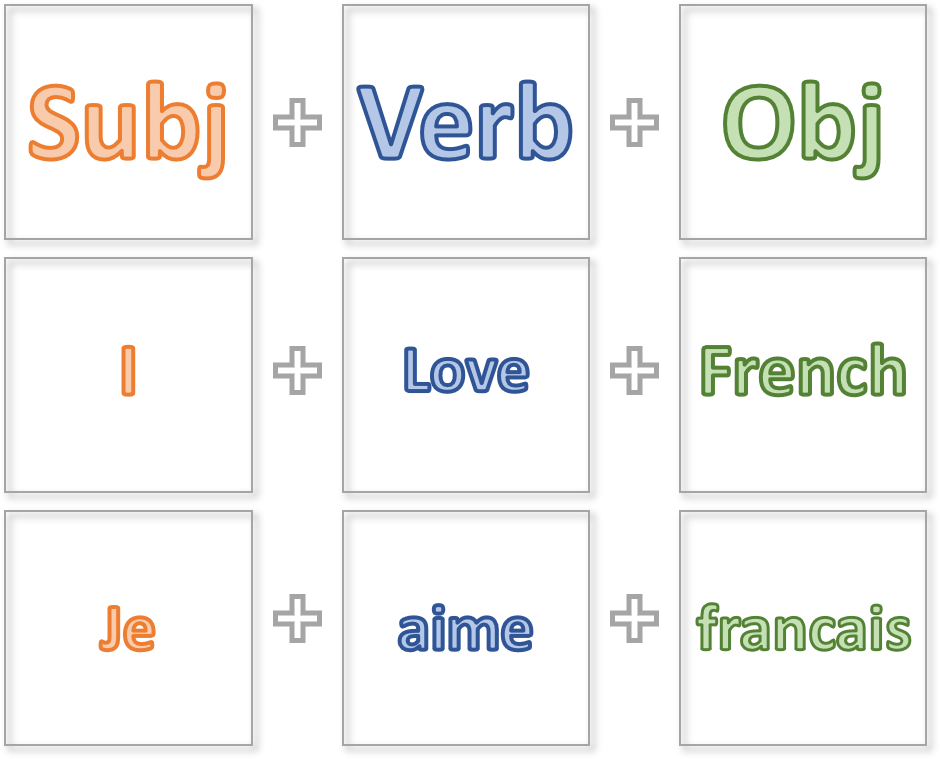
In French, pronouns that end in a vowel (je, tu) will shorten themselves if the word that comes after them starts in a vowel. This helps preserve flow when speaking.
Therefore “Je aime” becomes “J’aime”.
There is a common exception to this general SVO rule in French (not really sure if it should be called an exception or just an alternate rule due to how frequently it is used in colloquial French).
When the object of the sentence is a pronoun, it comes after the subject and before the verb.
So “I love you” becomes “Je t’aime” (te aime becomes t’aime).
Vocab
Bonjour – Hello
Je- I (n.)
M’appelle – Call myself
Voici – Here
C’est – This is
Mon – My
Blog – Blog
Langage – Language
Utilise – Use
Ce – This
Pour – For
Practicer – Practice
Francais – French
espère – Hope
Que – that
Vous – You all
Apprendez – Learn
Avec – With
Moi – Me
Text/Story
Bonjour!
Je m’appelle Chris.
Voici, c’est mon blog de langage.
J’utilise ce pour practice mon français.
J’espère que vous apprendez avec moi!
Translation
Hello!
My name is Chris.
This is my language blog.
I use this to practice my French.
I hope you can learn with me!
Translation Break Down
The general structure of the translation breakdown will be:
Original Text
English Translation
Word-by-word translation
Explanation
Bonjour!
Hello!
– This is the most common and neutral way to say hello.
Je m’appelle Chris
My name is Chris
Je (I), me (me), appeller (to call)
– Here is an example of a pronoun preceding the verb. This literally translates to “I call myself Chris”. It is the most common way of introducing yourself in French.
Voici, c’est mon blog de langage
This is my language blog.
Voici (Here), ce (this), etre (to be), mon (my), blog (blog), de (of), langage (language)
– Voici is similar to the widely known French word “Voila.” It is similar to saying “It’s here!” or “Here it is” in English.
– Etre conjugates to est.
– “C’est” is a combination two words: “Ce” and “est” (“this” and “is”).
– “De” here is acting as a descriptor/possessor. It is describing what kind of blog this is (a language one).
J’espère que vous apprendez avec moi!
I hope that you all can learn with me
Je (I), espèrer (Hope), que (that), vous (you all), apprendre (learn), avec (with), moi (me)
– Espèrer conjugates to espère
– Que functions virtually the same as in English. It is put after verbs to help connect the verb and the object to another verb.
– Vous is the plural form of tu. It can also act as a more respectful version of tu. For example, if you were talking to the president of the U.S. or your boss, you would use vous instead of tu (unless you were close with them).
– Avec functions the same as “with” in English.


 Language Learning With Chris
Merveilleux 🙂
Intelligent comme tu est
Sa sera très facile 🙂
LikeLike
Bravo pour ton site jeune homme !
LikeLike
You made this so logical to follow, that it actually makes learning fun!
Merci beaucoup!
LikeLike
Anonymous (Luc)
🙂
LikeLike
Bonjour Chris 🙂
Comment va tu ?
LikeLike
Bonjour Michel!
Je suis bien. Et tu?
Merci pour ton commentaire 🙂
LikeLike
Allô Chris 🙂
Comment va tu aujourd’hui ?
LikeLike