你好!
Today we are going to have a short introduction. We will learn:
How to say hello!
Basic sentence structure.
How to introduce yourself.
And more!
Basic Sentence Structure
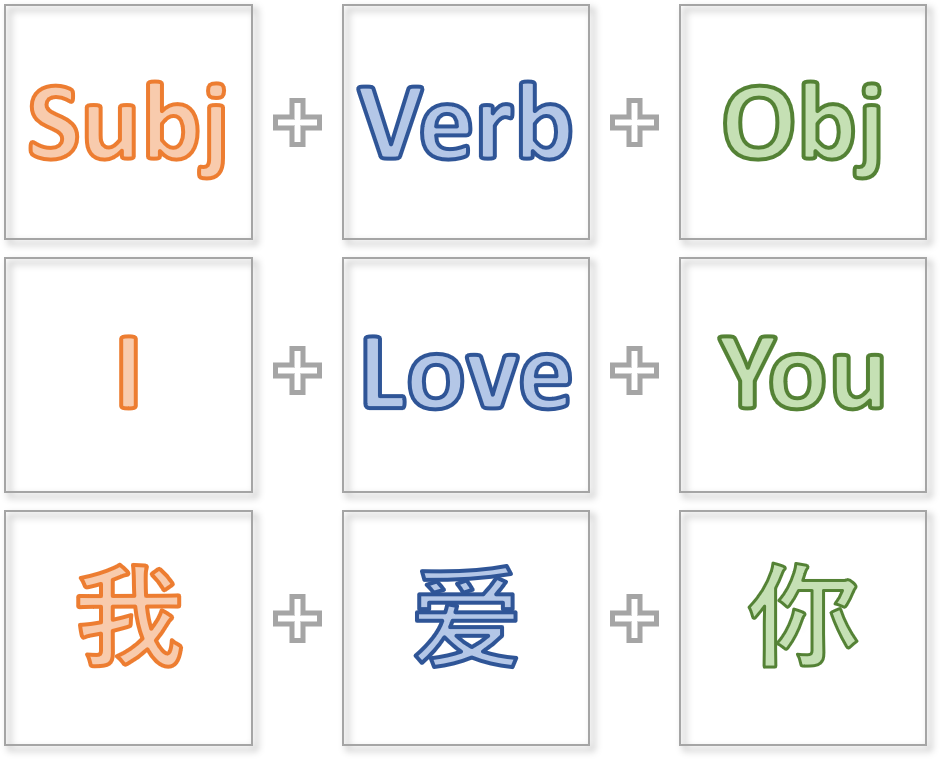
Chinese basic sentence structure is fairly simple (compared to French at least). It follows a similar pattern to English, Subject->Verb->Object. E.g. I love you (我爱你 ).
Following this logic, we can decipher others’ stories or create our own sentences or stories!
Vocab
你好 – Hello (n.)
我 – I (n.)
你 – You (n.)
叫 – Called (v.)
这 – This (n.)
是 – Is (v.)
博客 – Blog (n.)
用 – Use (v.)
练习 – Practice (v.)
中文 – Chinese (Language) (n.)
希望 – Hope (v.)
你们 – You all (n.)
也 – Also
学 – Learn, Study (v.)
Text/Story
你好!
我叫 Chris
这是我的博客。
我用这个练习中文。
我希望你们也可以学了。
Translation
Hello!
My name is Chris.
This is my blog.
I use this blog to practice Chinese.
I hope you can use it to learn as well.
Translation Break Down
The general structure of the translation breakdown will be:
Original Text
Pinyin
English Translation
Word-by-word translation
Explanation
你 好
Nǐ hǎo
Hello!
你 (You), 好 (good)
– This is the most common and neutral way to say hello.
我 叫 Chris
Wǒ jiào Chris
My name is Chris
我 (I), 叫 (called)
– This literally translates to “I am called Chris” but it functions the same as “My name is Chris”
这 是 我 的 博 客。
Zhè shì wǒ de bókè
This is my blog.
这 (This), 是 (is), 我的 (my), 博客 (Blog)
是 is the Chinese version of the verb “to be”.
– 的 is a possessive particle. It is placed in between two nouns to show one’s possession of the other. The former noun usually has possession over the latter. So this makes 我 的 (I “possession” blog) into “the blog owned by me (or “my blog”).
我 用 这个 博客 练习 中文。
Wǒ yòng zhège bókè liànxí zhōngwén.
I use this blog (to) practice chinese.
用 (Use), 这个 (this), 博客 (blog), 练习 (practice), 中文 (Chinese)
– 个 is a “measure word”. More on this later.
– The “to” is implied here. Chinese doesn’t usually have a specific word for “to”. It just skips “to” and goes into the verb.
我 希望 你们 也 可以 学了。
Wǒ xīwàng nǐmen yě kěyǐ xuéle.
I hope you all can learn too.
希望 (hope), 你们 (you all), 也 (also/too/as well), 可以 (can/to be able to), 学了 (learn)
– The 们 (men) in 你们 makes the “you” plural into “you all”.
– 也 ( yě ) is a particle added after pronouns to indicate “as well” or “too”.


 Language Learning With Chris
It’s pretty cringy
LikeLike
C’est vraiment super 🙂
Merci Chris 🙂
LikeLike
This is great!! Can’t wait to see this for French too! 🙂
LikeLike